

Cross vs. Crucifix: What Is the Difference?

Every crucifix is a cross. But not every cross is a crucifix.
The difference is easy to see. A cross is the familiar Christian symbol formed by two intersecting beams. A crucifix is a cross that includes an image of Jesus Christ crucified upon it.
But that simple definition leads to a more interesting question: if Christians believe that Jesus rose from the dead, why do Catholics so often place the suffering Christ before their eyes?
The answer has less to do with choosing the Crucifixion instead of the Resurrection and everything to do with holding the two together.
THE SHORT ANSWER
Cross vs. Crucifix
A cross has no figure of Christ upon it. A crucifix depicts Jesus crucified upon the Cross. Both are Christian symbols, and both point to the same Paschal Mystery: Christ’s saving death and Resurrection.
THE CHRISTIAN CROSS
What Does the Cross Mean?
Before the Cross became one of the most recognizable symbols in the world, it was an instrument of Roman execution.
Christianity transformed its meaning because of what happened upon it. Jesus did not simply die on a cross. Catholics believe that He freely offered Himself for the salvation of the world.
The Cross therefore came to represent far more than suffering. It represents sacrifice and redemption. Obedience and love. Death transformed into life.
It also recalls Christ’s invitation to His disciples to take up their own crosses and follow Him.
The Cross is not a celebration of suffering for its own sake. It is the sign of a love willing to give everything.
CHRIST UPON THE CROSS
What Does a Crucifix Add?
A crucifix makes one particular reality impossible to overlook: our salvation cost something.
We can become so accustomed to the Cross that it almost becomes an abstract shape. The crucifix restores the event to it.
There is a body there. Hands were pierced. A side was wounded. Christ suffered. Christ died. And He did so out of love.
The crucifix is therefore not intended to keep Catholics trapped at Good Friday. It keeps us from rushing past Good Friday on the way to Easter Sunday.
The crucifix does not deny Easter.
It tells us what Easter overcame.
THE RISEN CHRIST
But Isn't Jesus Risen?
Yes. Completely and gloriously.
Catholic faith does not end at the tomb. The Resurrection is the crowning truth of Christian faith, and it belongs together with the Cross at the heart of the Paschal Mystery.
That matters because the crucifix is sometimes misunderstood as though Catholics have forgotten that Jesus rose.
The opposite is true. We can look upon Christ crucified precisely because we know death did not have the final word.
The wounds shown on a crucifix are the wounds of a Savior who is now risen. Christianity does not erase suffering from the story of redemption. It proclaims that God entered into suffering, passed through death, and conquered it.
IN CATHOLIC CHURCHES
Why Are Crucifixes So Common?
The crucifix has a particularly important place in Catholic worship.
The Roman Missal directs that a cross bearing the figure of Christ crucified be placed on or near the altar and remain visible to the congregation. Its purpose is to call to mind the saving Passion of the Lord.
That is why entering a Catholic church so often means encountering a crucifix near the altar.
At Mass, Catholics do not gather around a generic idea of spirituality. They gather around the Paschal Mystery: the same Christ who offered Himself upon the Cross, rose from the dead, and remains alive.
The crucifix makes that mystery visible.
A COMMON MISUNDERSTANDING
Are Plain Crosses Protestant and Crucifixes Catholic?
That distinction is often repeated, but it is too simple.
Crucifixes certainly occupy a prominent place in Catholic tradition, and many Protestant traditions historically favored an empty cross. But the plain cross is not somehow non-Catholic.
Catholics wear simple crosses, display them in their homes, incorporate them into sacred art, and make the Sign of the Cross constantly in prayer.
The better distinction is not Catholic symbol versus Protestant symbol. A plain cross and a crucifix place visual emphasis on slightly different aspects of the same Christian mystery.
One presents the Cross itself. The other presents Christ upon the Cross.
WEARING THE SYMBOL
Can Catholics Wear a Plain Cross?
Yes. There is no general Catholic rule requiring a person to wear a crucifix rather than a cross.
Someone may be particularly drawn to a crucifix because it keeps Christ’s Passion vividly before them. Another person may wear a simple cross as a quiet and beautiful profession of Christian faith.
Neither choice changes the substance of Catholic belief.
What matters much more is what the symbol calls to mind. Does it remind us whom we belong to? Does it call us to prayer? Does it help us remember Christ in the ordinary moments of the day? Does it remind us that love sometimes requires sacrifice?
Then it is doing something far more important than simply completing an outfit.
ONE PASCHAL MYSTERY
Is a Cross or Crucifix Better?
It is probably better not to turn the two into competitors.
Catholic Christianity does not force us to choose between Calvary and the empty tomb. We need both.
We need to remember that Christ truly suffered and died. And we need to remember that He truly rose.
A crucifix makes Christ’s sacrificial love visible in an especially powerful way. A simple cross can proclaim that same mystery with extraordinary simplicity.
Either can become something we pass every day without noticing. Or either can become the small interruption we sometimes need:
Look again. Remember what He has done. And follow Him.
FAITH FOR HOME & EVERYDAY
Explore Crosses & Crucifixes
From crosses worn close to the heart to crucifixes placed in the home, these sacred signs can help keep the mystery of Christ’s love before us.
CONTINUE READING
Explore Related Catholic Guides
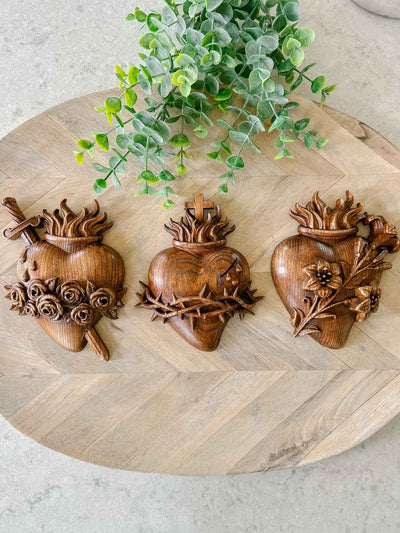
The Sacred Heart of Jesus
Discover the meaning of Christ’s Heart, wounds, flames and Cross.
Read the guide →Why Catholics Wear Medals
Learn how devotional objects fit within Catholic prayer and sacramental life.
Read the guide →The Miraculous Medal
Explore the history and symbolism of this beloved Marian medal.
Read the guide →Meditating on the Crucifix
A devotional reflection on looking closely at Christ’s sacrifice.
Keep reading →


Leave a comment