

The Memorare Prayer | History, Meaning & How to Pray It

There are moments when our intentions seem too heavy to carry neatly into prayer.
A child is struggling. A loved one is sick. A decision feels impossible. A relationship is wounded. We know we should pray, but perhaps we no longer know quite what to say.
For generations, Catholics have turned in moments like these to a short Marian prayer known as the Memorare.
Its opening words, “Remember, O most gracious Virgin Mary,” express remarkable confidence in the Blessed Mother’s intercession. Yet the prayer is not a promise that Mary will give us whatever outcome we ask for, nor does it place her in the place of God.
Instead, the Memorare teaches us to bring our needs honestly before Mary, ask her to pray for us, and entrust ourselves with her to the providence of God.
THE MEMORARE AT A GLANCE
What Is the Memorare Prayer?
The Memorare is a traditional Catholic prayer asking the Blessed Virgin Mary for her intercession. Its name comes from the Latin word memorare, meaning “remember.”
The prayer expresses confidence that Mary cares for those who seek her help and asks her, as the Mother of Jesus, to receive our petitions and intercede for us.
Catholics do not worship Mary when praying the Memorare. Worship and adoration belong to God alone. The Church teaches that Christian prayer is centered on Christ, the one Mediator, and that Mary always leads us toward her Son.
THE MEMORARE PRAYER
Remember, O most gracious Virgin Mary,
that never was it known
that anyone who fled to thy protection,
implored thy help,
or sought thy intercession,
was left unaided.
Inspired by this confidence
I fly unto thee,
O Virgin of virgins, my Mother.
To thee do I come,
before thee I stand,
sinful and sorrowful.
O Mother of the Word Incarnate,
despise not my petitions,
but in thy mercy hear and answer me.
Amen.
THE NAME OF THE PRAYER
What Does “Memorare” Mean?
Memorare is Latin for “remember.”
Like several traditional Catholic prayers, the Memorare became known by its opening word rather than by a separately assigned title.
But when we say, “Remember, O most gracious Virgin Mary,” we are not suggesting that Mary might otherwise forget us.
In the language of prayer, “remember” is an appeal to a relationship already established. Scripture itself frequently uses the language of asking God to “remember” his covenant or his people, not because God suffers from forgetfulness, but as an expression of trust in his faithfulness.
The rest of the prayer unfolds from that confidence.
A PRAYER OF CONFIDENCE
What Does the Memorare Mean?
The Memorare is remarkably short, but nearly every phrase teaches us something about Catholic prayer.
The first word places the prayer within a relationship.
Catholics believe Mary is not merely a figure from Christian history. She is alive in Christ and remains a member of the communion of saints.
The Catechism teaches that Mary’s spiritual motherhood extends to Christ’s brothers and sisters who still journey through the difficulties of this life.
Calling her “most gracious” does not make Mary the source of grace. God alone is the source of every grace. Rather, it recognizes what God has accomplished in Mary and the maternal love with which she prays for the Church.
This is the phrase that gives the Memorare its characteristic confidence.
It is not a contractual promise that every request made after reciting the prayer will produce the result we desire.
It expresses something deeper: confidence that Mary does not turn away those who sincerely seek her prayers.
A mother may faithfully hear the cry of her child even when the answer cannot be what the child hoped for. The Memorare asks us to pray with that same confidence.
Notice the movement of the prayer.
The person praying does not approach Mary because everything is already resolved. The prayer assumes vulnerability.
We fly to her precisely because something is wrong. There is fear, uncertainty, temptation, grief, need, or sorrow.
Christian confidence does not mean pretending those things do not exist. It means knowing where to bring them.
The prayer moves from the universal to the personal.
Mary is the Mother of Jesus and Mother of the Church, but the person praying also dares to call her: my Mother.
At the Cross, Jesus entrusted Mary and the beloved disciple to one another. Catholic tradition has long understood that moment as revealing Mary’s maternal relationship with Christ’s disciples.
The Memorare allows that theology to become intimate.
There is no self-justification here. We come as we actually are.
Sinful. Sorrowful. In need of mercy.
This phrase is one of the reasons the Memorare is more profound than merely calling it a prayer for “getting an answer.” Before asking for anything, we acknowledge our own poverty.
Our greatest need is not ultimately for circumstances to arrange themselves according to our wishes. Our greatest need is God.
This may be the most important phrase in the entire prayer.
Mary’s significance is inseparable from Jesus Christ.
She is the Mother of the Word Incarnate, the eternal Son of God who took flesh for our salvation.
The Catechism describes authentic Marian prayer in exactly this Christ-centered way: Mary shows the way, and the way is her Son.
We ask Mary to pray because of Christ.
And Mary ultimately leads us to Christ.
This language can sound unusual to modern ears.
Does Mary “answer” prayer?
Catholics do not believe Mary possesses an independent divine power by which she grants grace or changes events. Rather, this is the language of intercession.
When we say to a friend, “Please hear me and help me,” we are not confusing that friend with God. We are asking the person to respond to our need.
Similarly, we ask Mary to receive our petition and respond as a mother responds: by praying for us and bringing our needs before God.
God remains the giver of every grace.
TRUST WITHOUT A FORMULA
Does the Memorare Promise That Every Request Will Be Granted?
No.
And this distinction is essential.
The Memorare expresses extraordinary confidence in Mary’s intercession, but it does not promise that every illness will be cured, every marriage repaired, every financial need resolved, or every specific outcome granted simply because the prayer was recited.
Catholic prayer is not a mechanism for controlling God.
The Catechism provides a beautiful way to understand what happens when we entrust our petitions to Mary. Mary herself prayed, “Let it be to me according to your word.” When we entrust ourselves to her prayer, we join her surrender to God:
That changes how we understand the opening promise of the Memorare.
Mary does not abandon us simply because God’s answer is different from the one we hoped to receive.
Sometimes prayer changes circumstances. Sometimes God gives us strength to endure circumstances that do not change. Sometimes an answer becomes clear only years later. And sometimes a mystery remains a mystery.
The confidence of the Memorare is not confidence that we know what God must do next.
It is confidence that we can entrust ourselves to God without praying alone.
A PRAYER WITH A LONG HISTORY
Who Wrote the Memorare?
The Memorare has traditionally been attributed to St. Bernard of Clairvaux, the great 12th-century Cistercian abbot and Doctor of the Church.
There is certainly something fitting about the association. St. Bernard had a profound devotion to the Blessed Virgin Mary, and his surviving writings contain beautiful appeals to seek her prayers in times of danger and uncertainty.
But the history of the Memorare itself is more complicated.
The familiar prayer appears to be a shortened form of a longer Marian prayer, Ad sanctitatis tuae pedes, dulcissima Virgo Maria, whose known textual history dates to the 15th century, well after St. Bernard’s death.
That makes direct authorship by St. Bernard historically unlikely.
Father Claude Bernard and the Spread of the Memorare
The person most responsible for spreading the Memorare in its familiar form was another Bernard entirely.
Father Claude Bernard, a French priest who lived from 1588 to 1641, promoted the prayer extensively during his ministry.
Historical accounts report that he distributed approximately 200,000 printed copies in several languages, including among the prisoners to whom he ministered.
St. Francis de Sales also wrote that he had prayed the Memorare while he was a student in Paris.
By the 17th century, therefore, the prayer was becoming deeply established in Western Catholic devotional life.
SO DID ST. BERNARD WRITE THE MEMORARE?
Probably not in the form we know today.
It is better to say: The Memorare has long been associated with St. Bernard of Clairvaux, but its actual author is unknown, and its surviving textual history appears to be later than his lifetime.
That does not diminish the prayer.
Many of the Church’s most beloved prayers developed gradually through generations of Christian devotion rather than being composed at one identifiable moment by one identifiable author.
MAKING THE PRAYER YOUR OWN
How Do You Pray the Memorare?
There is no required ritual for praying the Memorare.
You do not need special beads. You do not need to say it a certain number of times. And you do not need to wait until a crisis.
You can simply begin.
If you have a particular intention, name it before the prayer:
Then pray the Memorare slowly enough to hear what you are saying.
The Catechism cautions that memorized prayer should not remain merely memorized; Christians should be helped to savor the meaning of the prayers they know.
That is especially fitting with the Memorare.
Do not rush past sinful and sorrowful.
Do not rush past Mother of the Word Incarnate.
Then, when the prayer ends, allow your petition to remain where you have placed it.
You have asked Mary to pray.
Now entrust the answer to God.
WHY CATHOLICS ASK MARY TO PRAY
Why Pray to Mary Instead of Going Directly to God?
You can and should pray directly to God.
Catholic devotion to Mary does not replace prayer to the Father, Son, or Holy Spirit.
The Church teaches unequivocally that Jesus Christ is the one Mediator between God and humanity. Christian prayer reaches the Father through Christ.
So why ask Mary to pray?
For essentially the same reason Christians ask one another for prayer.
If you call a friend before surgery and say, “Please pray for me,” you have not stopped believing that Christ is your Mediator. You have invited another member of Christ’s Body to intercede with you.
Catholics believe death does not destroy the Body of Christ.
The saints remain alive in him.
And Mary occupies a unique place within that communion because she is the Mother of Jesus and the woman who cooperated in faith with God’s plan from the Annunciation through the Cross and beyond.
The Catechism therefore teaches that Christians may pray with Mary and ask for her intercession, while also emphasizing that she is wholly transparent to Christ and always directs us toward him.
It asks Mary to help us follow Jesus.
PRAYER IN ORDINARY LIFE
When Should You Pray the Memorare?
One reason the Memorare has endured is its simplicity.
It can fit into ordinary life.
You might pray it when you are afraid about one of your children; when someone you love is ill; before a difficult conversation; while discerning a decision; when a marriage or friendship is strained; when someone has wandered from the faith; during grief; when temptation feels particularly strong; when you have been asked to pray for someone and do not know what else to say; or simply as a regular part of daily prayer.
It can also be prayed before or after the Rosary, although the Memorare is not itself part of the Rosary.
There is no wrong hour of the day and no circumstance too ordinary to bring before God.
The value of learning a short prayer by heart is that it becomes available when elaborate prayer is not.
Remember, O most gracious Virgin Mary…
And that is enough to begin.
COMMON QUESTIONS
Memorare Prayer FAQ
Is the Memorare a Catholic prayer?
Yes. The Memorare is a traditional Catholic Marian prayer and is included by the United States Conference of Catholic Bishops among the Church’s familiar traditional prayers.
What does “Memorare” mean?
Memorare is Latin for “remember.” The prayer takes its name from its opening word.
Who wrote the Memorare?
Its exact author is unknown. It has traditionally been attributed to St. Bernard of Clairvaux, but the familiar prayer appears to derive from a longer Marian prayer whose known history dates to the 15th century. Father Claude Bernard helped popularize the shorter Memorare during the 17th century.
Does the Memorare guarantee a miracle?
No. The prayer expresses confidence in Mary’s intercession, not a guarantee that God will grant a particular temporal outcome. Catholic prayer always remains open to God’s wisdom and providence.
Can a non-Catholic pray the Memorare?
Yes. Nothing prevents a non-Catholic from asking Mary to pray for him or her. Someone unfamiliar with Catholic Marian devotion may find it helpful first to understand that Catholics do not worship Mary and do not believe she replaces Jesus.
Why does the Memorare ask Mary to “hear and answer” us?
This is devotional language asking Mary to receive our petition and respond through her maternal intercession. Catholics do not believe Mary is the independent source of grace. God alone gives grace.
Is the Memorare part of the Rosary?
No. The traditional prayers of the Rosary do not include the Memorare. However, Catholics may freely pray it before or after a Rosary or use it separately for a particular intention.
How many times should you pray the Memorare?
There is no required number. It may be prayed once, repeated during a period of special need, or incorporated into daily prayer. Repetition should foster trust and attention rather than become a formula for obtaining a desired outcome.
DEVOTION IN DAILY LIFE
Keeping Mary Close in Daily Prayer
The Catholic tradition has always understood physical reminders as capable of turning our attention back toward God.
A Rosary resting beside the bed. A small image of Our Lady near a desk. A prayer card tucked inside a Bible.
None of these objects replaces prayer. But in the middle of a distracted day, they can remind us to begin.
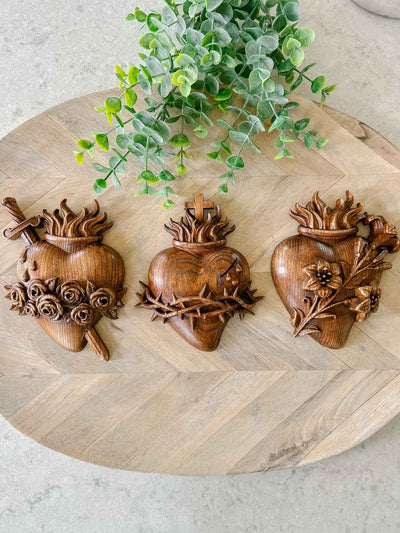
For those looking to make Marian prayer a more visible part of ordinary life, House of Joppa offers:
What matters most is not accumulating devotional objects. It is allowing the things around us to draw our attention toward the life we are trying to live.
A FINAL REFLECTION
The Confidence of the Memorare
The Memorare begins with confidence.
But Christian confidence is different from certainty that life will unfold the way we want.
It is the confidence to come before Mary sinful and sorrowful, without pretending that we have everything together.
It is the confidence to ask for help.
It is the confidence to believe that the saints pray with us.
And ultimately, it is the confidence to entrust what we love to God.
When we pray the Memorare, we place what weighs upon us into the hands of a Mother who loves her Son perfectly. We ask her to pray with us, and then, with Mary, we learn again the prayer at the heart of all Christian trust:
Thy will be done.


Thanks for this explanation, very enlightening. Mother Mary, intercede for our company, which is at the verge of bankruptcy. May the Lord intervene through your intercession.
Please pray for me and my cousin. That we both receive favorable medical results.
Thank you so much for this wonderful prayer.I testify that this prayer works wonders.
I pray Blessed Mother Mary, intercede for my son Charles for success in his matrimony and wedding preparations due in July. Amen
Please pray for my friend’s 83 year old father, Father Santos in Malawi who is very sick in the hospital, thank you
Leave a comment